
At different points over the years, Taylor has featured 12-fret guitars among its model offerings. The unique build configuration not only changes the relationship between the neck and body of the guitar, it also changes the relationship between the player and the guitar, translating into a uniquely appealing feel and sound.
So, what exactly makes 12-fret guitars different? Here’s everything you need to know.
Twelve Frets to the Neck
Standard acoustic guitars feature a design that joins the neck to the body at the 14th fret. A 12-fret guitar, as you might guess, features a neck that meets the body at the 12th fret. This different connection point will create subtle differences in both feel and sound. (More on that in a bit.) A 12-fret neck is shorter, with two fewer total frets along the fretboard (18 versus 20).
The Bridge Location Is Shifted
On a 12-fret guitar, the bridge is shifted farther away from the soundhole, closer to the center of the lower bout. To understand this effect, it’s important to note that the string scale length—the maximum vibrating string length, measured from the nut to the saddle—of a 12-fret guitar is the same as that of a standard 14-fret guitar. The vast majority of 12-fret guitars we’ve produced at Taylor are crafted with the Grand Concert body shape. Our most compact full-size shape, the Grand Concert features a string scale length of 24-⅞ inches in both 12- and 14-fret configurations.
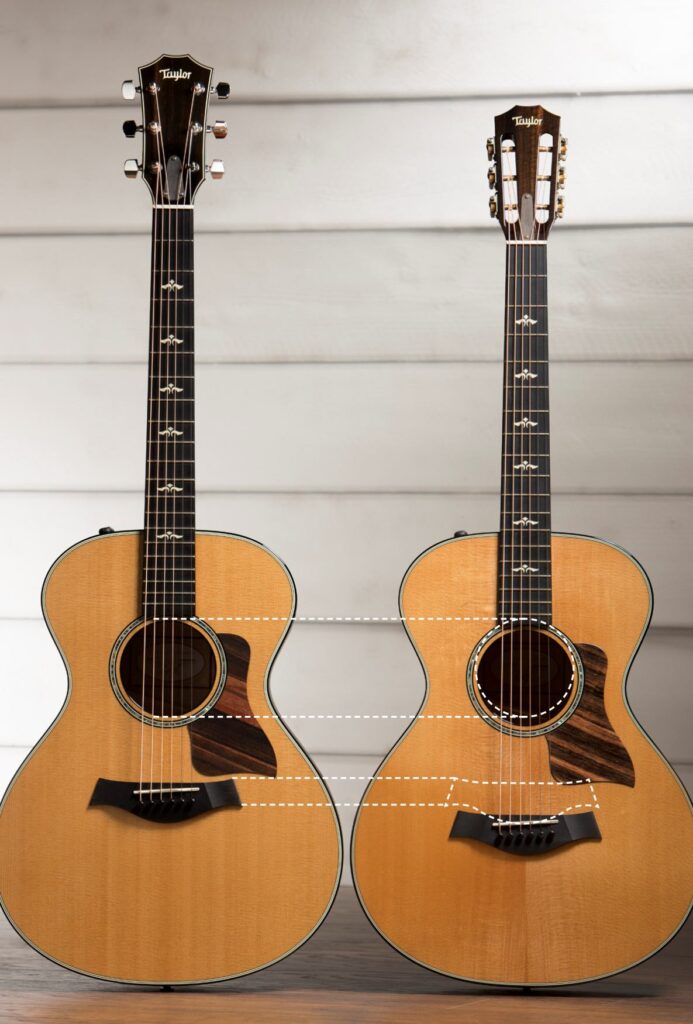
Because the scale length is the same but the 12-fret neck meets the body two frets closer to the nut, the bridge has to move toward the other end of the guitar, closer to the center of the lower bout. This will change the soundboard movement and as a result, the tonal response.
A Different Handfeel
In terms of playability, the 12-fret neck-to-body configuration will noticeably affect how the guitar feels in your hands. Because the neck is two frets shorter, the result is a more compact feel, with your strumming and fretting hands closer together than they would be with a 14-fret guitar. Many guitarists find this increases playing comfort, in part because bringing the hands closer together helps your entire body feel a bit more relaxed.
A Different String Response
Taylor typically pairs the 12-fret neck with a slotted headstock, whose more acute string break angle at the nut changes how the strings respond beneath the fretting hand. This gives the strings more precision and resistance to bending near the nut, while the bridge’s position farther away from the soundhole contributes to a more relaxed feel elsewhere along the string.
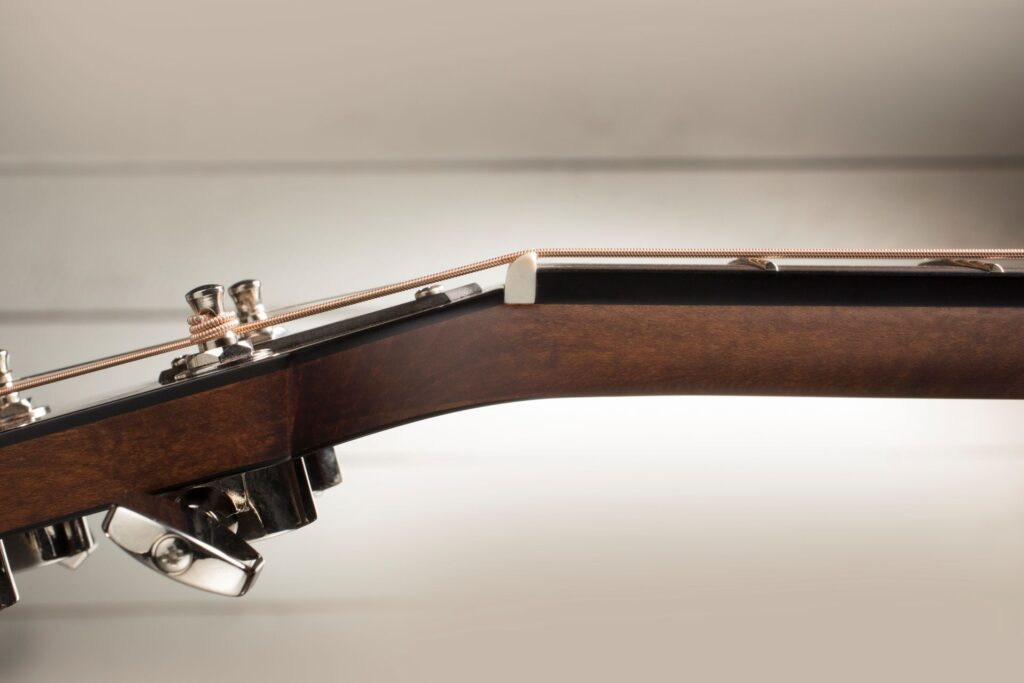
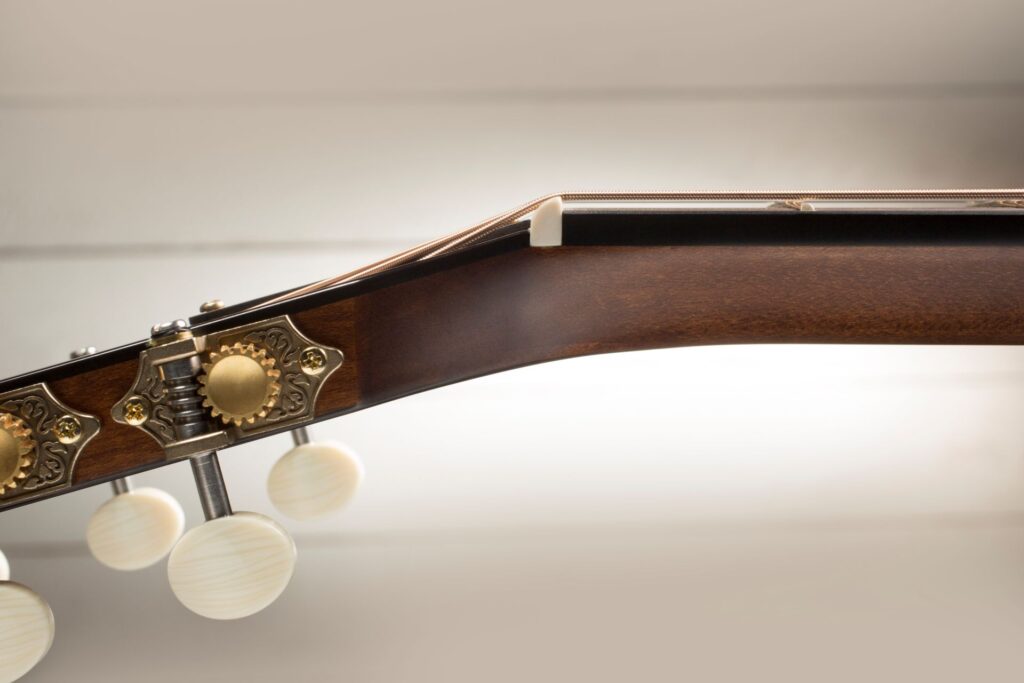
“With the shifted bridge placement, the top moves a little more,” Andy explains. “So you’ll feel a little less tension on the picking hand and a little extra tension close to the nut. They kind of equalize each other, but it’s a different distribution.”
Together with the Grand Concert’s 24-⅞-inch scale length—slightly shorter than the 25-½-inch scale length on Taylor’s larger body shapes—players also get the benefit of slightly condensed fret spacing, which can reduce hand fatigue and make more advanced chord voicings easier.
A Different Tonal Response
Sonically, the shifted bridge position on a 12-fret changes the way the string energy sets the top in motion. Being closer to the center of the lower bout, the bridge sits in an area of the top that’s naturally more flexible.
As an example, Andy Powers describes the effect of a drumstick hitting a snare drum head.
“Hit the drum head near the rim and you’ll hear a brighter sound than when you hit the very center,” he says. “The mostly circular form of the lower bout on an acoustic guitar behaves similarly.
“With 12-frets, because that more central location on the top is more flexible, you get a bit more warmth, a little more midrange swagger,” he adds. “And because the design is very physically efficient, it has strong projection, which gives it a husky power for its compact size.”
And it’s not just the transfer of vibration that creates this effect—it’s also the physical relationship between the player and guitar. The compact Grand Concert body shape already sits a bit lower on the player’s lap when playing seated, and moving the bridge toward the middle of the lower bout changes where your strumming/picking hand will naturally interact with the strings.
“With the string length shifted more centrally across the player’s body, the fretting hand will often feel more relaxed, and the strumming hand will likely articulate the strings from a warmer sounding spot farther from the saddle,” Andy explains.
A Brief History of 12-Fret Guitars
The 12-fret design has a history that dovetails with the early era of steel-string acoustic guitars. Twelve-frets were more common in the early decades of the 1900s, but starting in the 1930s, the design was gradually replaced by longer necks with 14 frets clear of the body. It was part of a design evolution that was influenced by makers of mandolins, whose necks had been getting longer, banjos, which featured a much longer neck, and archtop guitars, which were growing in popularity at that time. It wasn’t long before a 14-fret configuration would become the new standard with steel-string acoustic guitars.
Taylor’s Modern 12-Fret Revival
Though 12-frets had largely been viewed as an old-fashioned design in the modern era, Andy Powers saw an opportunity to revisit and update the design in the context of the modern player, especially when coupled with a cutaway-style body. (Cutaways weren’t common on acoustic guitars back when 12-frets were popular a century ago.)
“Pairing the 12-fret neck design with a cutaway body blends the warmer midrange response with the accessibility to the upper register,” Andy said in 2016 when Taylor rolled out an array of 12-fret models as part of its guitar lineup. “You still get to play the high notes.”
Other Taylor design innovations since then have made 12-frets an even more musically appealing option for players. Andy’s tone-enhancing V-Class voicing architecture, including a newer scalloped version of V-Class, coaxes more low-end fullness, open-string richness and enhanced responsiveness from the 12-fret guitar form.
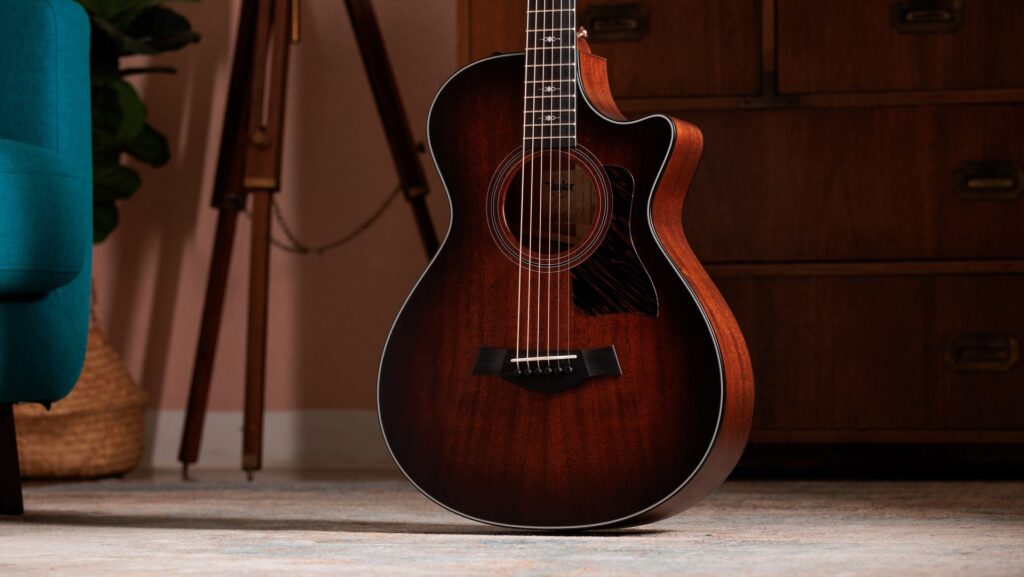
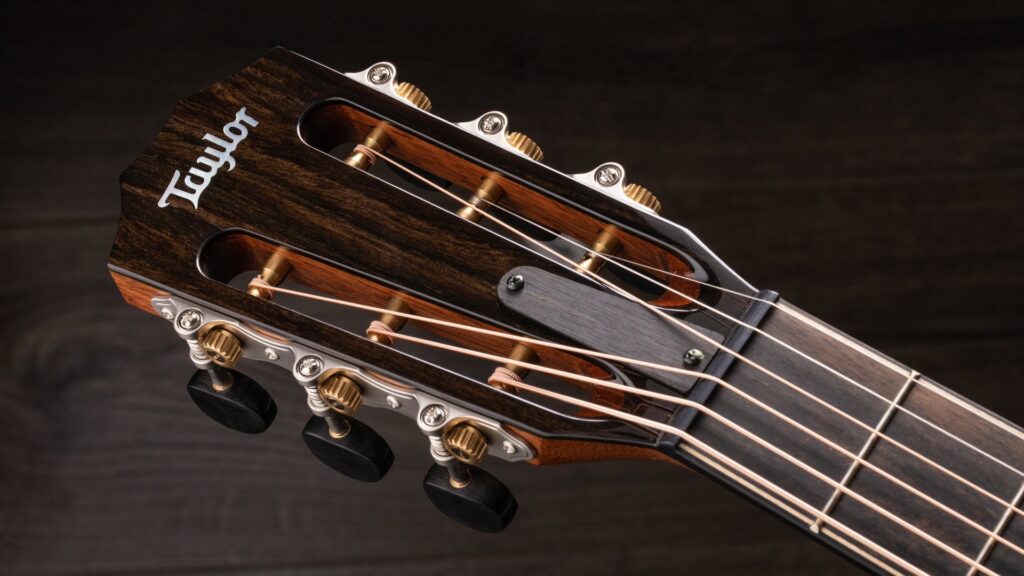
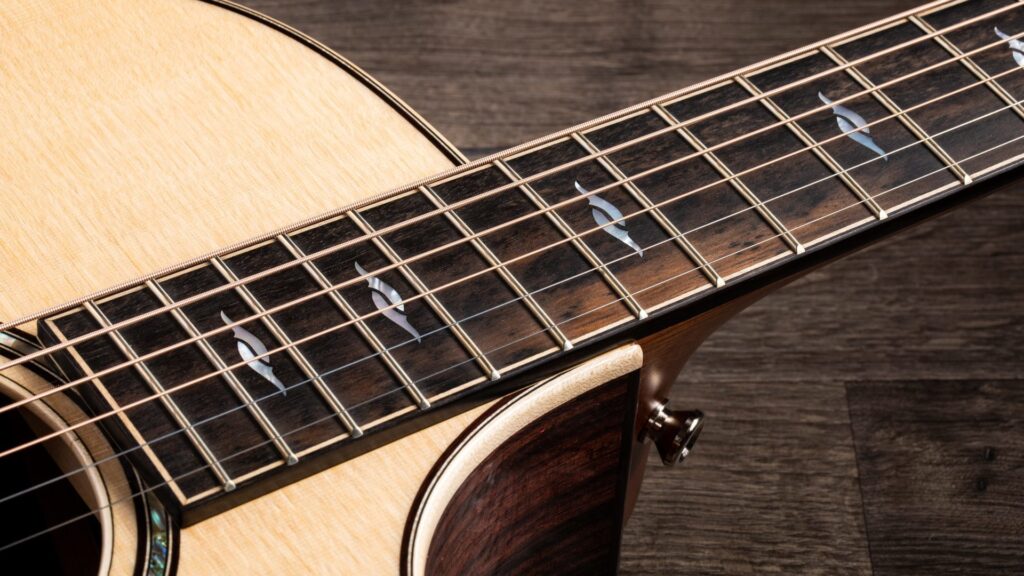
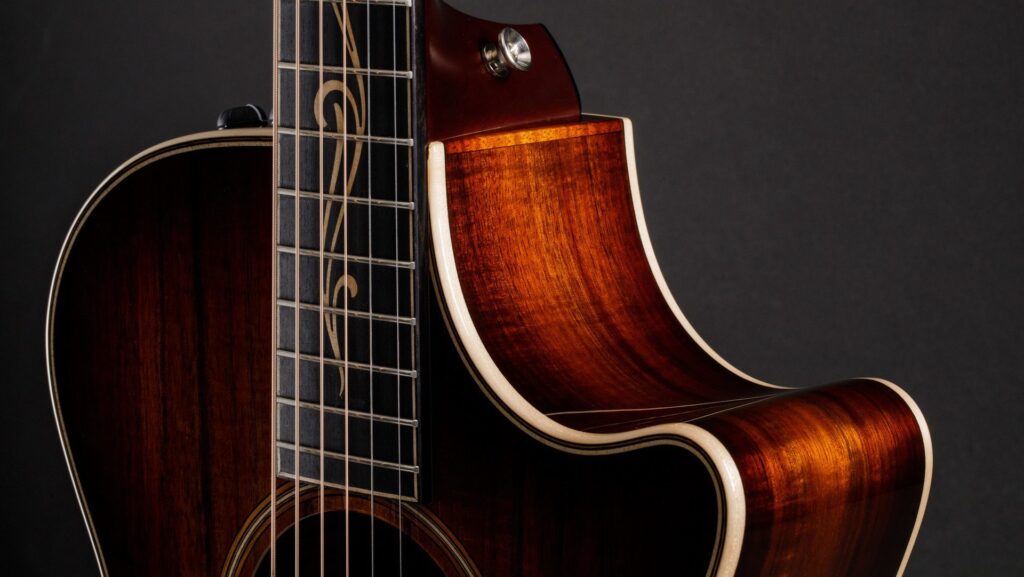
One especially interesting 12-fret variant that Taylor has made in recent years is the 12-string 552ce 12-Fret, which brings the shimmering octave richness of a 12-string voice into a compact, ultra-comfortable form. Between the compact Grand Concert body and 12-fret configuration, it stands out as one of the most playable 12-strings in the Taylor catalog.
What Kind of Player Is a 12-Fret Guitar For?
Because of their exceptional playing comfort and rich midrange character, 12-fret acoustic guitars are remarkably versatile and can cover a wide swath of musical territory.
The compact cutaway Grand Concert shape has long been popular among fingerstyle players for its comfortable lap position, responsive feel and articulate voice. The 12-fret configuration amplifies that intimate playing experience, while modern voicing enhancements give these guitars plenty of dynamic range and projection for roots music styles like blues, Americana, country and folk, with enough power to serve strummers who like to dig in with a pick. Their sonic clarity and balance also make them excellent instruments for recording.
A 12-fret is worth considering for any type of player who prefers a more compact playing experience or who finds a shorter neck and condensed fret spacing more hand-friendly.
The best way to discover whether its distinctive feel and voice are right for you is to play one alongside a 14-fret model to feel and hear the difference for yourself.
What 12-fret guitars are currently available from Taylor?
These are the 12-fret acoustic guitars that are featured in the Taylor lineup today: